Deriving Mercury Geodetic Parameters With Altimetric Crossovers From the Mercury Laser Altimeter (MLA)
Stefano Bertone
This study uses crossover analysis of MESSENGER Mercury Laser Altimeter (MLA) observations to derive updated constraints on Mercury's geodetic parameters. By minimizing elevation differences at locations where distinct MLA ground tracks intersect, the analysis simultaneously solves for orbit corrections, Mercury's pole orientation, spin rate, libration amplitude, and the tidal Love number h2. The resulting solution is consistent with published rotational parameters, places Mercury in a Cassini state with obliquity ? = 2.031 ± 0.03 arcmin, and provides a first data-based estimate of the vertical tidal Love number h2 = 1.55 ± 0.65. These results are relevant to Mercury geodesy and to studies of the planet's internal structure, including its moment of inertia and core properties.
Background
Mercury's rotational state is a key observable for constraining the distribution of mass within the planet and, therefore, its internal structure and thermal evolution. Before and during the MESSENGER mission, Mercury's orientation and spin were estimated through a range of methods, including Earth-based radar, spacecraft radio tracking, and co-registration of topography and imagery. This work provides an independent solution based on altimetric crossover analysis of MLA data using the PyXover software package.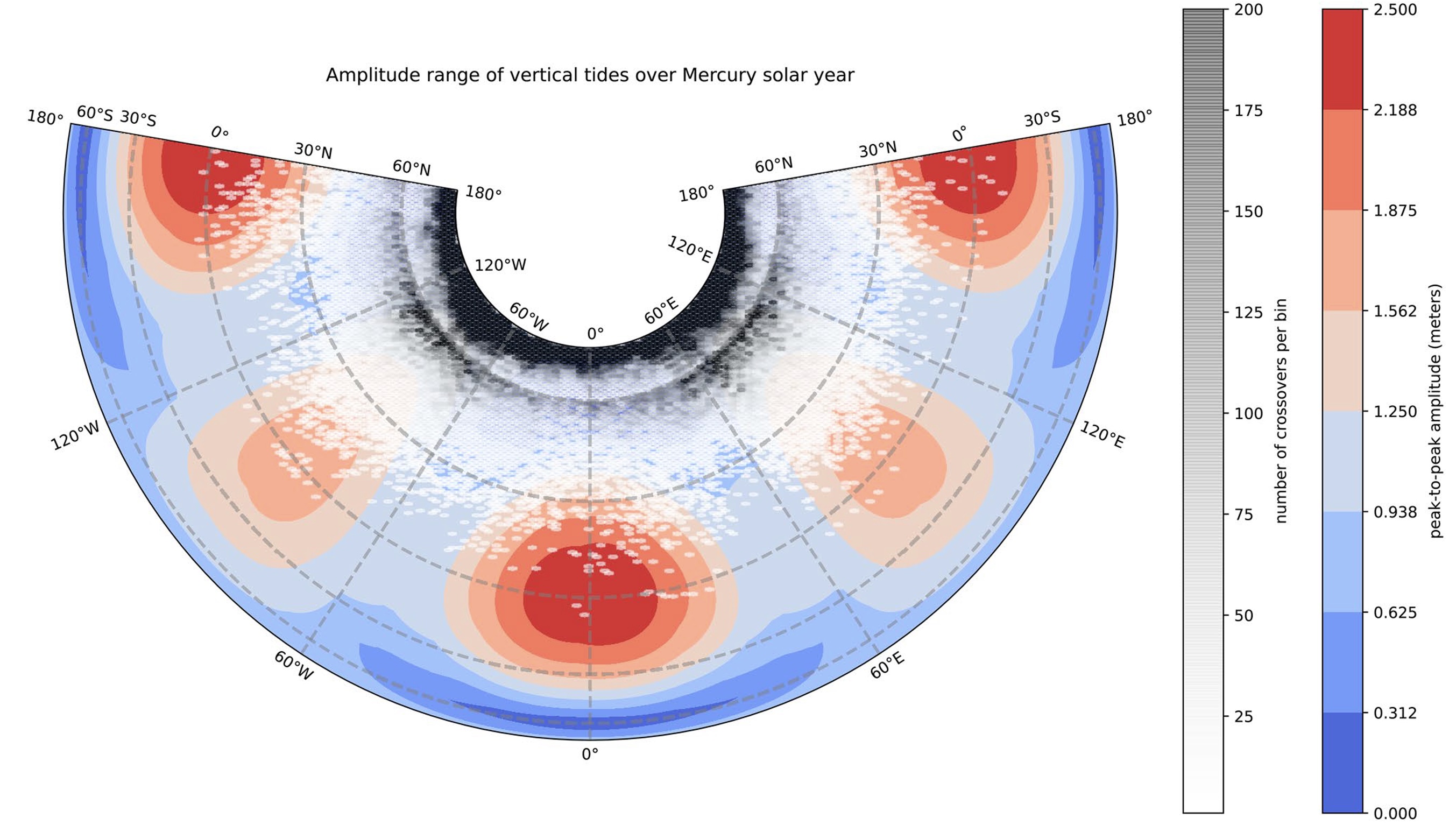
Figure 1. Geographic distribution of MLA crossovers superposed on expected Mercury tidal deformation patterns, illustrating why the vertical Love number h2 is difficult but still measurable from altimetric crossovers.
A key motivation of the study is that no previous data-based estimate of Mercury's vertical Love number h2 had been produced. Because tidal vertical displacements are small and MLA coverage is concentrated in the northern hemisphere (see Fig. 1), measuring h2 from spacecraft observations is challenging. This analysis demonstrates that crossover differences carry sensitivity not only to orbit and orientation errors, but also to Mercury's tidal response.
Data and method
The analysis uses MLA ranging observations collected during the MESSENGER mission, together with spacecraft orbit and attitude information distributed through NAIF/SPICE. MLA acquired more than 22 million surface-height measurements, and the full data set yields on the order of 3 million crossovers, mostly in Mercury's northern hemisphere. In crossover analysis, the same surface location is observed at different times from two distinct tracks; differences in the measured elevation can then be modeled as arising from orbit and pointing errors, interpolation effects, mismodeled planetary rotation, or tidal deformation (see Fig. 2).
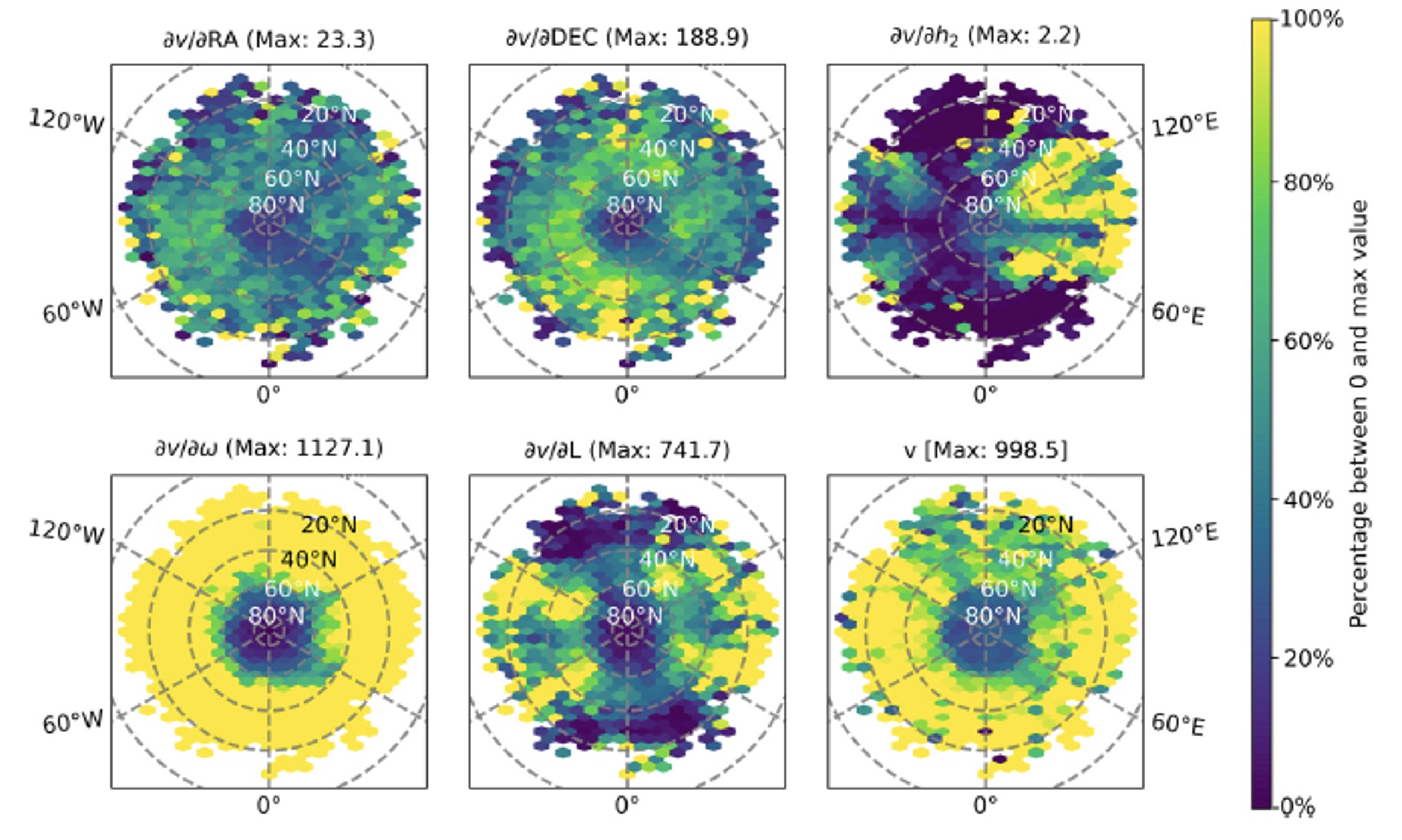
Figure 2. North-polar stereographic view of MLA crossover sensitivity to Mercury rotational and tidal parameters, together with the geographic distribution of pre-fit crossover discrepancies.
The study models crossover discrepancies as a function of corrections to spacecraft orbital parameters, together with corrections to Mercury's right ascension and declination of the pole, spin rate, libration amplitude, and tidal Love number h2. These parameters are estimated iteratively by least squares within the PyXover software. The workflow includes geolocation of MLA shots, crossover identification and refinement, computation of observation partial derivatives, weighting of crossover quality, and constrained solution of the resulting normal equations (see Fig. 3). Observation weights account for track quality, interpolation noise, off-nadir geometry, and abnormal residuals, while weak constraints are applied mainly to stabilize orbital corrections. The solution strategy is further supported by variance component estimation and by extensive validation against simulated data, alternative a priori orbit solutions, and different data subsets.
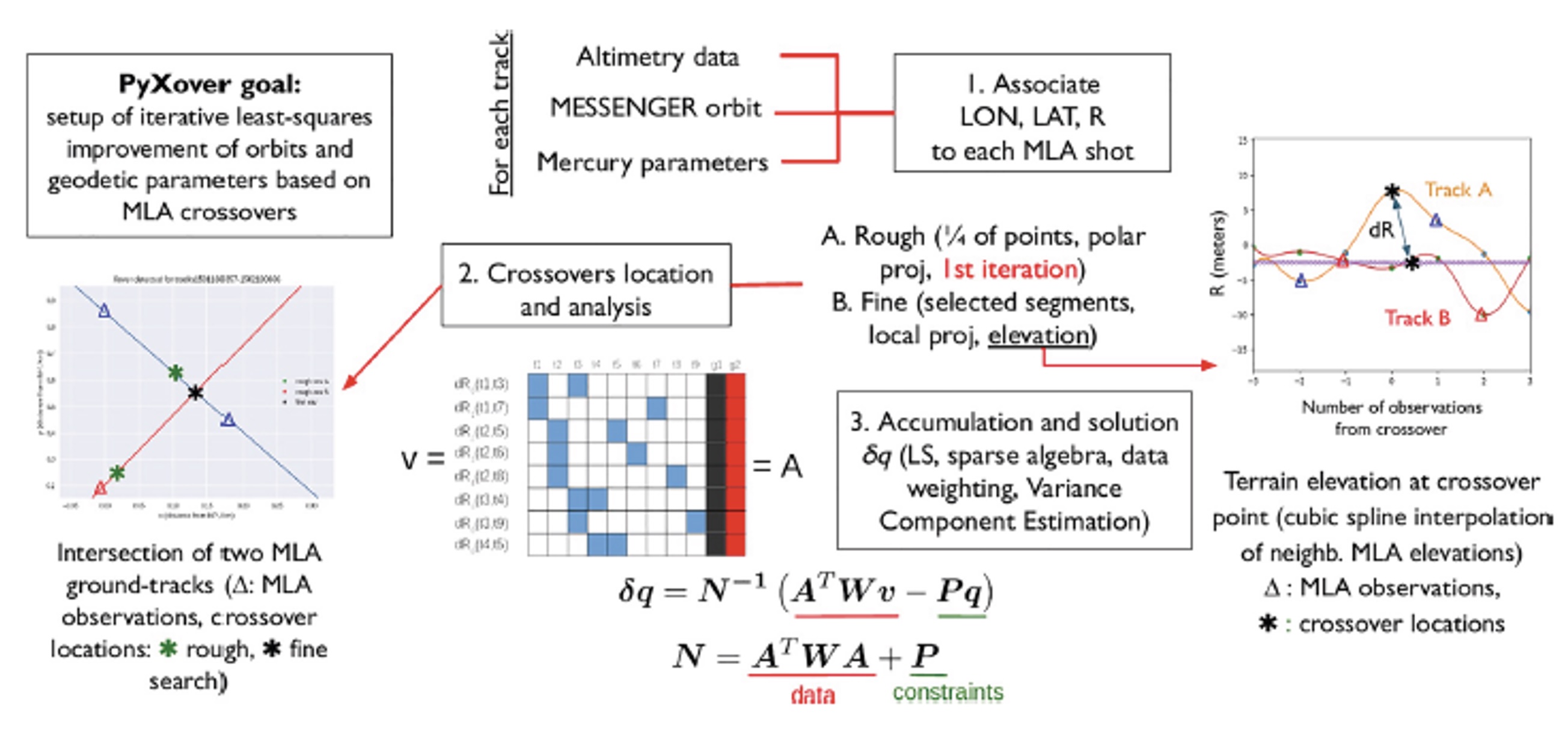
Figure 3. Workflow of the PyXover crossover-analysis software used to geolocate MLA measurements, identify crossovers, and solve simultaneously for orbit corrections and Mercury geodetic parameters.
Key results
The final solution yields Mercury pole coordinates RA = 281.0093° and DEC = 61.4153°, spin rate ? = 6.138510°/day, libration amplitude L = 39.03 arcsec, and h2 = 1.55, as shown in Fig. 4. After calibration for systematic effects, the study reports that Mercury is consistent with a Cassini state and has an obliquity ? = 2.031 ± 0.03 arcmin. The inferred normalized polar moment of inertia is C/MR2 = 0.343 ± 0.006.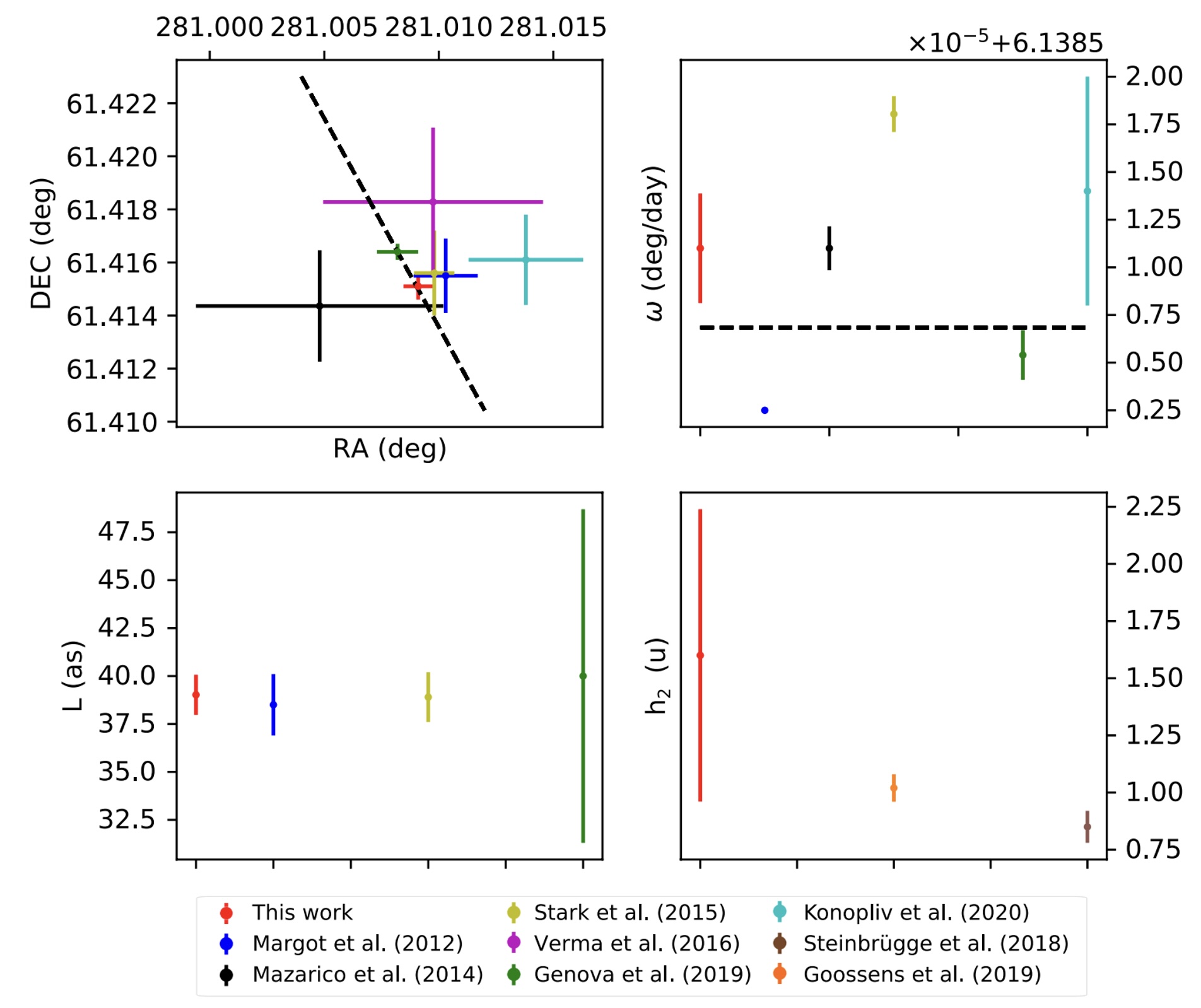
Figure 4. North-polar stereographic view of MLA crossover sensitivity to Mercury rotational and tidal parameters, together with the geographic distribution of pre-fit crossover discrepancies.
The study also interprets the new geodetic parameters in terms of Mercury's internal structure. Combining the rotational solution with interior modeling yields an estimated outer core radius of about 2020 ± 50 km, larger than some gravity-based estimates and closer to values inferred from crust-sensitive measurements (see Fig. 5). The h2 result, although still imprecise, provides a first experimental constraint on Mercury's vertical tidal response and is broadly consistent with the presence of a solid inner core.
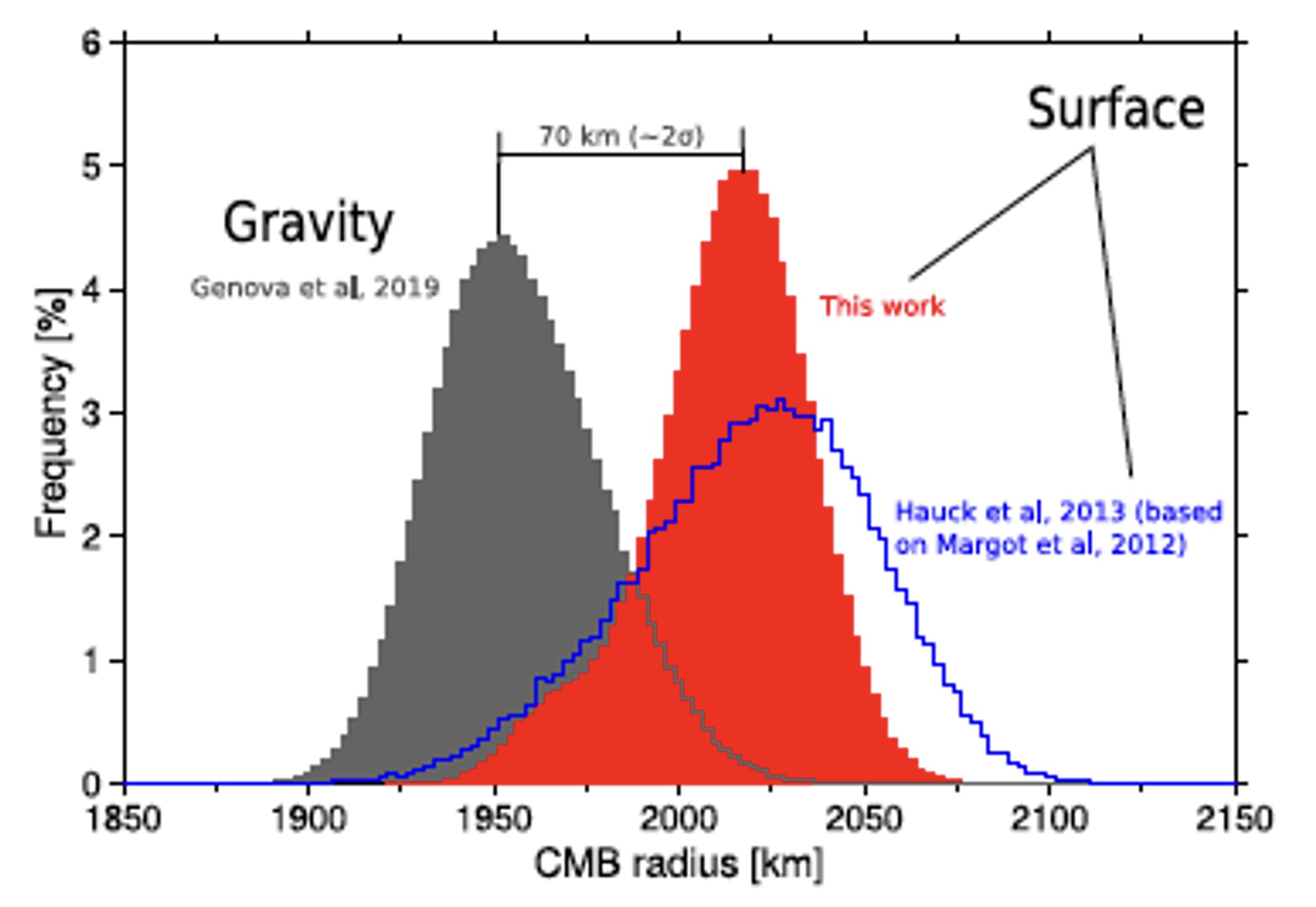
Figure 5. North-polar stereographic view of MLA crossover sensitivity to Mercury rotational and tidal parameters, together with the geographic distribution of pre-fit crossover discrepancies.
Data Usage Policy
Please cite the following reference when using any of the products described above:Bertone, S., Mazarico, E., Barker, M. K., Goossens, S., Sabaka, T. J., Neumann, G. A., & Smith, D. E. (2021). Deriving Mercury geodetic parameters with altimetric crossovers from the Mercury Laser Altimeter (MLA). Journal of Geophysical Research: Planets, 126, e2020JE006683, doi:10.1029/2020JE006683.
If using the PyXover software, please cite:
Bertone, S., Barker, M. K., & Mazarico, E. (2020). PyXover - A Python suite of altimetry analysis tools for planetary geodesy. Zenodo. 10.5281/ZENODO.4312137.
References
Bertone, S., Mazarico, E., Barker, M. K., Goossens, S., Sabaka, T. J., Neumann, G. A., & Smith, D. E. (2021). Deriving Mercury geodetic parameters with altimetric crossovers from the Mercury Laser Altimeter (MLA). Journal of Geophysical Research: Planets, 126, e2020JE006683, doi:10.1029/2020JE006683.
Bertone, S., Barker, M. K., & Mazarico, E. (2020). PyXover - A Python suite of altimetry analysis tools for planetary geodesy. Zenodo. 10.5281/ZENODO.4312137.
Archinal, B. A., et al. (2018). IAU Working Group report on cartographic coordinates and rotational elements: 2015.
Genova, A., et al. (2019). Geodetic evidence that Mercury has a solid inner core. Geophysical Research Letters, 46, 3625-3633, doi:10.1029/2018GL081135.
Neumann, G. (2018). MESSENGER MLA derived data bundle. Geosciences Node. doi:10.17189/1518575.
Other MESSENGER and Mercury's ephemeris used in this work: https://pgda.gsfc.nasa.gov/products/71